
The Admission
The attorney cleared his throat three times before speaking. 'Your Honor, these emails represent private family communications regarding estate planning and property management. We didn't consider them relevant to the current dispute regarding ownership claims.' His voice was smooth, practiced, but I could hear the defensiveness underneath. The judge set down the papers and removed her glasses. 'Counselor, these emails specifically discuss establishing residence, documenting contributions, and building a legal case for ownership. That seems directly relevant to a dispute about ownership claims, wouldn't you say?' He shifted in his chair. 'The communications may appear strategic in hindsight, but they reflect legitimate family planning, not fraud or conspiracy.' Alex stood. 'Your Honor, the emails explicitly state intentions to claim property rights through incremental establishment of ownership. That's not planning, that's premeditation.' The judge held up one hand, stopping the argument. She looked tired suddenly, like she'd seen this kind of thing too many times before. The judge's expression hardened, and she said, 'I'll be reviewing these materials carefully—this hearing is continued for one week.'
 Image by FCT AI
Jennifer's Confession
Jennifer texted me Saturday afternoon: 'Can we meet? Please. Alone.' We met at a park forty minutes outside town, nowhere anyone would recognize us. She looked terrible—red eyes, no makeup, her hands shaking as she sat down on the bench. 'I can't do this anymore,' she said immediately. 'I can't watch what's happening and pretend I don't know.' My heart started pounding. 'Know what?' She stared at her hands. 'Mom started talking about you the week after she met you. She did research on your property, looked up the deed, checked the property values. She told Daniel you were perfect.' The word hit me like a slap. 'Perfect for what?' 'For the plan. She'd been looking for the right opportunity, the right person. Someone with valuable property, no close family, someone Daniel could actually make himself marry.' Her voice cracked. 'Mom had this whole plan mapped out,' Jennifer said, tears streaming down her face, 'and Daniel—he went along with it because he always does what she wants.'
 Image by FCT AI
The Pattern Emerges
I showed Alex everything Jennifer had told me Monday morning. She listened without interrupting, her expression getting darker with each detail. Then she pulled out a file I hadn't seen before. 'I've been researching Margaret's history. She was involved in another property dispute in 2018, before you met Daniel. The case settled confidentially, but I found the initial filings.' She spread papers across her desk. 'The pattern is identical, Sarah. The family member moves in, establishes residence, documents every contribution, claims they were promised ownership, forces litigation until the original owner settles just to make it stop.' My chest felt tight. 'How long has she been doing this?' Alex pulled out more documents. 'I found references to three other disputes going back twenty years. All settled, all confidential, all involving similar circumstances.' She pointed to timeline she'd constructed. 'Look at the sequence—infiltrate, document, contribute, claim, litigate. It's the same playbook every time.' Alex laid out the timeline: infiltrate, document, contribute, claim, litigate—and said, 'She's done this before, and she knows exactly how it works.'
 Image by FCT AI
The Research
Nina called me Tuesday evening, her voice strange. 'I found something. Two families who dealt with Margaret in property disputes. One in 2011, one in 2004. Sarah, their stories sound exactly like yours.' She'd tracked them down through court records, cross-referenced names, spent hours on genealogy sites and property databases. We drove to meet the first family Wednesday afternoon, a couple in their sixties who'd lost their vacation home near the coast. They sat in their small apartment and told me everything. How Margaret's son had befriended their daughter, how the family had slowly integrated themselves, how the legal battle had drained their savings until they'd had no choice but to settle. 'We lost the house and a hundred thousand dollars in legal fees,' the wife said. 'We had to declare bankruptcy.' The husband's hands trembled. 'She knew exactly what she was doing. Every step was calculated.' They showed me photographs of their old house, documents from their case, emails that could have been copied from my own life. One of the families agreed to talk, and when they told their story, it was like listening to my own future—except they'd lost everything.
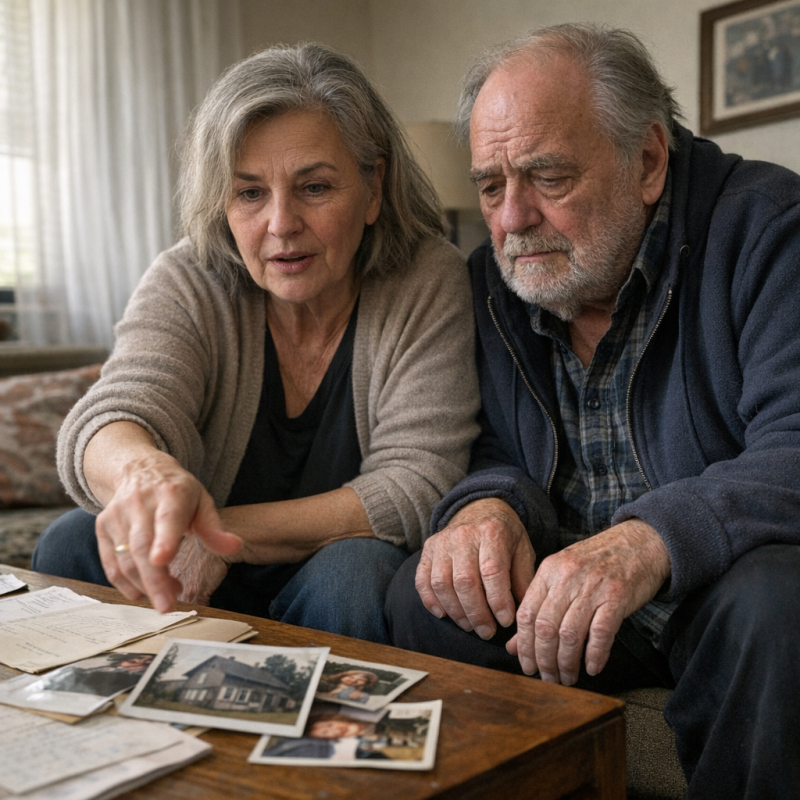 Image by FCT AI
The System
Alex called an emergency meeting Thursday morning. Her desk looked like a detective's investigation board—documents, timelines, financial records spanning decades. 'Sarah, sit down. You need to see all of this.' She'd compiled everything: the previous victims, the settlement amounts, property records, even Margaret's financial history. 'This isn't about your house. This has never been about wanting to live at the lake or keeping a family home. Margaret has been running a calculated legal scheme for decades.' She pointed to the evidence. 'She identifies targets—people with valuable property and emotional vulnerabilities. She uses family members to establish claims that exploit gray areas in property law. Then she forces litigation that's expensive enough to make settlement the rational choice.' The numbers were staggering. Conservative estimates put Margaret's gains at over three million dollars across twenty-three years. 'She's made a business out of this,' Alex continued. 'The family connections aren't relationships—they're access points. The contributions aren't generosity—they're documentation. Every move is calculated to build a legal claim.' 'It's not about the house,' Alex said, spreading out documents spanning twenty-three years, 'It's about exploiting legal gray areas in property law—and she's made millions doing it.'
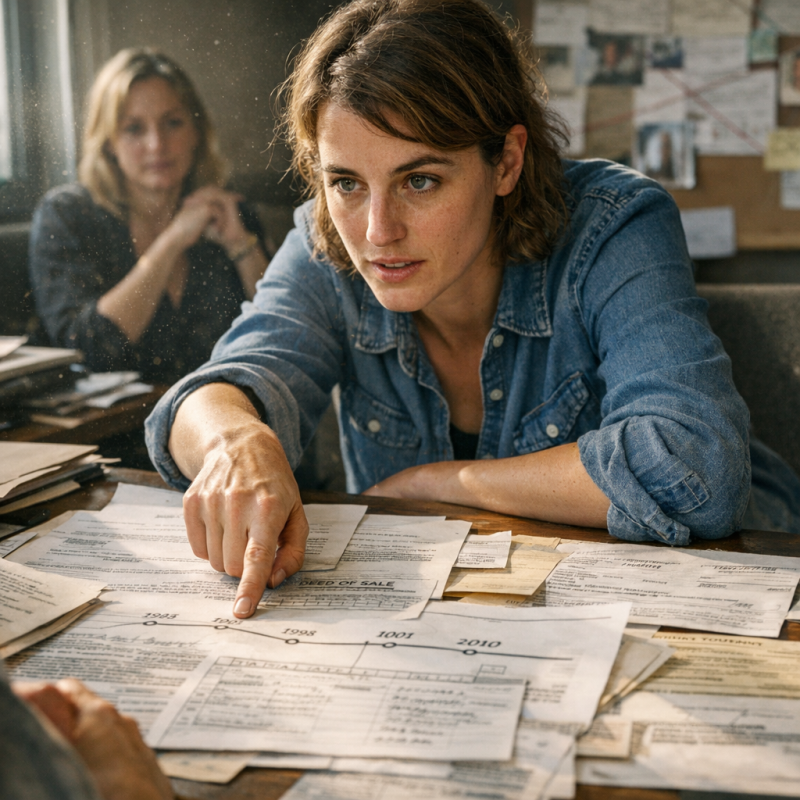 Image by FCT AI
The Decision
That Thursday afternoon, something shifted inside me. I sat across from Alex, staring at twenty-three years of Margaret's calculated destruction laid out on her desk. Seven families. Three million dollars. Decades of perfected manipulation. And I realized—defending myself wasn't enough. Winning my case wouldn't stop her. She'd just find another target, another vulnerable person with property she wanted, another family member to exploit. 'We have everything we need to win your case,' Alex said carefully, watching my face. 'The judge will rule in your favor.' I shook my head. 'That's not enough.' My hands were steady as I reached across the desk, touching the files of families she'd destroyed. 'She'll do this again. To someone else. Someone who won't have the resources to fight back.' Alex leaned forward, and I saw something like pride in her eyes. 'What are you saying?' I looked at Alex and said, 'I want to go on the offensive—I want to destroy her.'
 Image by FCT AI
Building the Case
Alex made the first call that afternoon. Within twenty-four hours, we had contact information for six of Margaret's previous victims. The Johnson family in Connecticut. The Ramirez property dispute in New Mexico. The Thornton case from 2008. One by one, they answered our calls, and I heard my own story reflected back in different voices. 'We settled because we couldn't afford to keep fighting.' 'The emotional toll was destroying our family.' 'She seemed so reasonable at first, so generous.' Each conversation added another piece to the puzzle. Alex's associate compiled financial records, settlement agreements, property transfers. The prosecutor Alex connected us with—a woman named Jennifer Chen who specialized in white-collar offenses—started asking very specific questions about intent, pattern, documentation. She didn't promise anything, but her interest was unmistakable. 'Keep gathering evidence,' she told us. 'If this is what it looks like, we'll move fast.' By the end of the week, we had statements from seven families, financial records showing settlements totaling $4.2 million, and a prosecutor who was very interested in talking.
 Image by FCT AI
The Confrontation
The continued hearing was scheduled for Tuesday morning. But this time, Margaret walked into a very different courtroom. Detective Barnes stood near the back wall, his presence unmistakable. Alex had arranged everything perfectly—the prosecutor had opened a formal investigation, and while the civil case proceeded, implications loomed. When Margaret's attorney began his presentation, Alex stood. 'Your Honor, before we continue, there's additional evidence the court needs to see.' She presented documentation of the pattern—seven victims, twenty-three years, millions in settlements. Margaret's face remained composed, but I saw Richard shift uncomfortably in his seat. The judge reviewed the materials in silence that stretched like wire. 'Mrs. Hayes, I'm going to ask you some direct questions,' the judge said, but before she could respond, Detective Barnes stepped forward. 'Your Honor, I need to interrupt.' He looked directly at Margaret. Margaret's composure finally cracked when the detective said, 'Mrs. Hayes, you have the right to remain silent'—and I watched everything she'd built start to crumble.
 Image by FCT AI
The Collapse
Everything fell apart fast after that. Margaret's attorney withdrew from the case within three hours, citing 'irreconcilable differences with the client.' Richard showed up at Alex's office that afternoon without calling first, asking what kind of deal he could make in exchange for testimony. 'I didn't know the full scope,' he kept saying, though nobody believed him. 'I thought it was just this once.' Alex negotiated with the prosecutor—Richard's cooperation in exchange for reduced liability. Then, around seven PM, my phone rang. Daniel. I almost didn't answer. 'Sarah, please.' His voice sounded unfamiliar—raw, frightened. 'I've been talking to Richard. The prosecutor wants to interview me. They're asking about what I knew, when I knew it.' I stood by my apartment window, watching traffic below. 'And what are you telling them?' 'The truth. That I—' He stopped. Started again. Daniel's voice was shaking: 'I didn't know how deep this went, I swear—please, you have to believe me,' but I couldn't tell anymore what was real and what was rehearsed.
 Image by FCT AI
The Media Storm
The headline hit the Washington Post Thursday morning: 'Wealthy Socialite Accused of Decades-Long Property Scheme Targeting Family Members.' By noon, it was everywhere—CNN, local news, legal blogs, even a segment on morning television. Nina called me before I'd finished my coffee. 'Sarah, there are reporters outside your building.' I stayed inside. Let Alex handle the media inquiries. But my phone wouldn't stop—messages from journalists requesting interviews, emails from lawyers representing people who thought they might be victims too, even a call from a documentary producer. The scrutiny was intense and weirdly impersonal. Strangers analyzed my marriage on Twitter. Legal experts debated Margaret's tactics on cable news. Someone created a Reddit thread tracking all the known victims. Around three PM, my phone buzzed with a new text. Margaret. I stared at her name on my screen for a full minute before opening it. My phone exploded with messages from reporters, lawyers representing other potential victims, and a text from Margaret that said simply: 'You've destroyed this family.'
 Image by FCT AI
The Plea Deal
The prosecutor moved quickly. By Monday, they'd presented Margaret with an offer: plead guilty to fraud, conspiracy, and unlawful property schemes. Make full restitution to all identified victims. Forfeit any and all property claims permanently. Or face trial with evidence from eight families and potential prison time. Alex called me with updates throughout the day. Margaret hired a new attorney—one who specialized in plea negotiations rather than courtroom combat. 'She's going to take it,' Alex predicted. 'She can't risk trial.' The formal plea hearing was Wednesday. I sat in the gallery with Alex, watching Margaret stand before the judge in a gray suit that looked too heavy for her frame. Her new attorney did most of the talking. Margaret answered the judge's questions in a voice I barely recognized—quiet, stripped of her usual commanding tone. 'Do you understand you're waiving your right to trial?' 'Yes, Your Honor.' Afterward, in the courthouse hallway, I saw her for just a moment. Margaret's new attorney advised her to take the deal, but in the courthouse hallway, she looked at me with pure venom and said, 'This isn't over.'
 Image by FCT AI
Daniel's Truth
Daniel asked to meet me one last time. Not at a coffee shop or restaurant—somewhere private. We ended up at his temporary apartment, a corporate rental near his office that felt as impersonal as a hotel. He looked different. Thinner. Older. 'I need to tell you everything,' he said. 'The real version.' And then he did. He'd known about Margaret's plan from the beginning. She'd approached him six months before the wedding, laying out the strategy—contribute to renovations, establish presence, build documentation. 'She made it sound reasonable,' he said. 'Like we were just protecting family assets.' But he'd known. Known what it would mean. Known I'd be the target. 'Why?' I asked. He looked at his hands. 'Because for my entire life, I've been trying to be the son she wanted. And when she finally included me in something important, treated me like I was capable and strategic instead of disappointing—' His voice broke. 'I loved you,' he said, 'but I loved the idea of being the son she was proud of more,' and I realized that was the most honest thing he'd ever told me.
 Image by FCT AI
The Settlement
The wire transfer hit my account on a Tuesday. Margaret's restitution fund—administered by the court, divided among verified victims. My portion covered every legal fee, every expense, every dollar I'd spent fighting her. Plus damages. The property deed arrived by courier that same afternoon, formally releasing all claims, signed by Margaret's attorney and certified by the court. Permanent. Irrevocable. I called Alex immediately. 'Come over,' she said. 'We should celebrate.' But when I got to her office, she took one look at my face and just poured us both coffee instead. We sat in silence for a while, the documents spread between us. Everything I'd fought for. Complete legal victory. The lake house secured. Margaret neutralized. Justice, by any definition. Alex raised her coffee cup. 'You won—completely.' I looked at the papers, at the proof of my victory, at the end of the nightmare. As I held the final signed documents, Alex said, 'You won—completely,' but I didn't feel victorious, just exhausted.
 Image by FCT AI
The Last Goodbye
We met at Marcus's office—neutral ground, all business. Daniel looked thinner. Older. He signed the divorce papers without reading them, like he'd already memorized every word. 'I'm sorry,' he said, and I believed him. Not because it mattered, but because I could finally hear the truth in his voice. 'I know,' I said. We sat there for a moment in Marcus's conference room, the same room where this whole legal battle had started. 'I loved you,' Daniel said quietly. 'I just didn't know how to choose you over her.' And there it was—the admission I'd been waiting for. Except now that I had it, I realized it didn't change anything. The papers were signed. Margaret's hold on the property was severed. Our marriage was over. He stood, hesitated like he might say something else, then just left. I watched him walk down the hallway, shoulders hunched, defeated. Marcus offered to stay, but I shook my head. I needed a moment alone with this particular ending. As Daniel walked away from the attorney's office, I realized I wasn't sad about losing him—I was sad about never really having him at all.
 Image by FCT AI
Rebuilding
Six months later, I drove up to the lake house on a Friday afternoon in early September. The driveway looked different—overgrown in spots, peaceful in a way it never had been during those family weekends. I'd hired a service to maintain it, but I hadn't been back since that final confrontation. The key turned smoothly in the lock. Inside, everything was exactly as I'd left it, minus the tension. I walked through each room slowly, reclaiming the space inch by inch. This was mine. Really, truly mine. No one could take it. No one could manipulate their way in. I made coffee in my kitchen, sat on my deck, watched the light change on the water. It felt different now—not like a trophy or a battlefield, but just a house. My house. The sun was setting, painting everything gold and pink, when my phone rang. Nina. 'Hey,' she said, and I could hear the smile in her voice. 'The group wants to meet again. But this time...' She paused. As I stood on the deck watching the sunset, Nina called to say the victims' support group wanted to meet again—this time, to celebrate.
 Image by FCT AI
New Beginnings
I started the consulting business three months after the divorce finalized. Property Rights Protection Services—helping people navigate family real estate disputes before they became nightmares. Alex helped me set up the LLC. Nina spread the word through her network. Turns out, there were a lot of people out there dealing with versions of what I'd survived. Mothers-in-law with 'concerns.' Family members who wanted 'input' on major purchases. Relatives who thought shared DNA meant shared ownership. I knew every manipulation tactic, every legal loophole, every emotional trap. I'd lived it. Survived it. Learned from the best attorneys how to fight it. My website went live on a Monday. By Wednesday, I had five consultation requests. By Friday, I'd signed my first official client. She was twenty-eight, newly married, and her mother-in-law kept making 'suggestions' about their first home purchase. 'She just wants to help,' my client said, and I heard the uncertainty in her voice. The same uncertainty I'd felt once. My first client was a young woman whose mother-in-law was making 'suggestions' about their new home purchase, and I knew exactly how to help her.
 Image by FCT AI
The Lake House
I hosted the gathering on a warm Saturday in October, exactly one year after everything started. Not family—never again that kind of family. Nina came early to help set up. Alex brought wine and war stories from her latest cases. Marcus arrived with his partner, whose sister had dealt with a similar property dispute. Three women from the victims' support group. Two of my new clients who'd become friends. We filled the deck, the living room, the kitchen I'd fought so hard to keep. There was laughter—real laughter, not the performative kind from those awful family weekends. There were stories, solidarity, understanding. Someone proposed a toast 'to chosen family,' and we all raised our glasses. The sun set over the lake, and I looked around at these people who'd chosen to be here, who knew my whole story and showed up anyway. No one was performing. No one was manipulating. No one wanted anything from me except my company. As I looked around at the people filling my home with genuine warmth and laughter, I realized this was what family was supposed to feel like, and I was finally free.
 Image by FCT AI