
The Uneasy Truce
The next few weeks were strange. Lorraine followed the new rules precisely. She was pleasant with Carla, who returned to her regular schedule. She didn't comment when Daniel and I went out for the evening. She attended her medical appointments without drama. On the surface, everything had changed. But I couldn't shake the feeling of walking on ice, waiting for the crack. Daniel seemed lighter, though. He'd started therapy—individual sessions to work through what he was calling 'a lifetime of unhealthy patterns.' He apologized to me more than once for not seeing it sooner, for not protecting me better. I told him we'd both been in it, both learning. Carla, perceptive as always, picked up on the shift immediately. 'Whatever happened,' she said to me quietly one morning, 'it needed to happen.' The household had a rhythm now, clear boundaries and defined roles. But every time I passed Lorraine reading in her chair or heard her cheerful good morning, I remembered that cold satisfaction in her eyes. We had won the battle—but the conflict felt far from over.
 Image by FCT AI
Lorraine's Apology — Sort Of
Three weeks after our confrontation, Lorraine asked to speak with me privately. My guard went up immediately, but I agreed. We sat in the living room, the same room where she'd admitted her manipulation so casually. 'I've been thinking,' she began, her hands folded in her lap. 'About what happened. What I did.' I waited, saying nothing. 'I may have... pushed too hard. With you and with Rachel before you. My methods were perhaps more extreme than necessary.' It wasn't quite an apology. The words were careful, calculated. 'But you have to understand,' she continued, 'everything I did came from a place of love. Of wanting to protect my son from making mistakes.' There it was—the justification, the reframing. She couldn't just apologize. Couldn't just admit she'd been wrong. I looked at her steadily. 'I understand that you believe that,' I said. She studied my face for a long moment, and something like respect flickered across her features. She said, 'You're stronger than I expected'—and I wasn't sure if that was praise or warning.
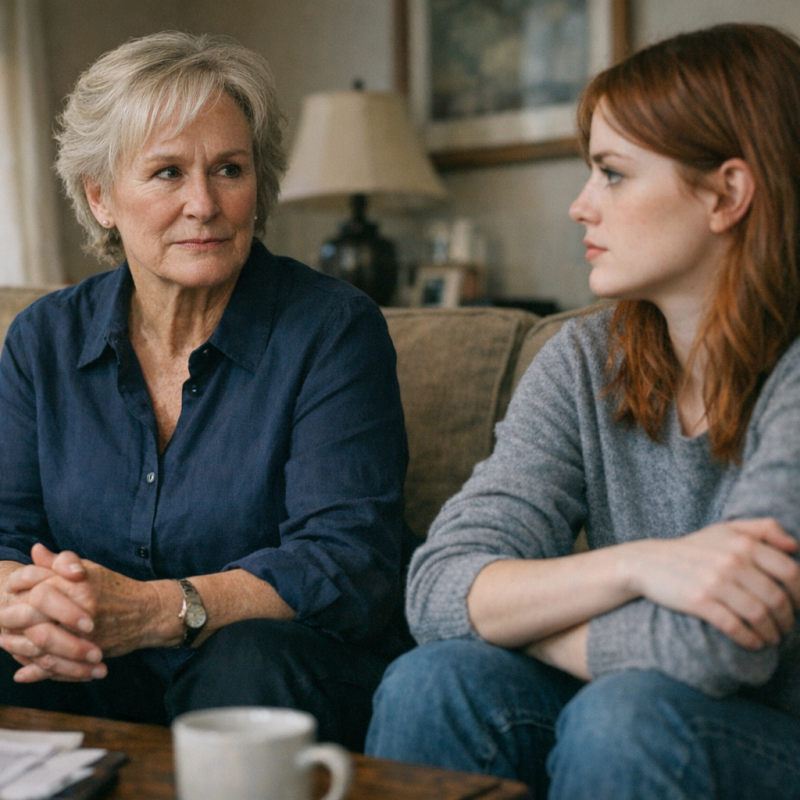 Image by FCT AI
Daniel's Growth
A week after that conversation with Lorraine, Daniel came home with a business card. 'I found a therapist,' he said, setting it on the counter between us. 'Someone who specializes in family dynamics. I made an appointment for next Tuesday.' I picked up the card, turning it over in my hands. I'd suggested therapy months ago, back when everything was falling apart, but he hadn't been ready then. 'What changed?' I asked. He looked at me with an honesty I hadn't seen in a long time. 'You did. You set boundaries when I couldn't. You protected yourself when I failed to protect us.' His voice cracked slightly. 'And I realized I don't know how to do this—how to be a partner instead of just reacting to whatever my mother needs.' Over the following weeks, I watched him go to those sessions. He came home quieter sometimes, processing things he'd never questioned before. One evening, as we sat together after dinner, he reached for my hand. 'I need to learn how to be a husband, not just a son.'
 Image by FCT AI
The New Normal
Six months later, our household had found its rhythm. Carla arrived each morning at nine, and Lorraine had stopped treating her like an intruder. They'd developed their own rapport—professional but warm. Lorraine had her routines, her space, her independence. Daniel and I had ours. Sunday dinners were still tense occasionally, but the explosions had stopped. Lorraine no longer ambushed me with criticisms or tried to rearrange my kitchen. When she had an opinion, she voiced it once, then let it go. Daniel had learned to notice when she was manipulating, and he'd started calling it out gently but firmly. 'Mom, that's not fair,' he'd say, and she'd retreat. I'd learned to speak up before resentment built, to say 'no' without guilt consuming me afterward. Carla became more than hired help—she became a buffer, yes, but also a witness. Her presence reminded everyone we'd made agreements, established boundaries. The house no longer felt like a battleground. It wasn't perfect—but it was sustainable.
 Image by FCT AI
Reflections on Boundaries
Looking back now, I can see how close I came to disappearing completely. For months, I'd absorbed every criticism, swallowed every frustration, convinced myself that keeping the peace was worth the cost. I'd stopped voicing opinions. Stopped taking up space. Stopped recognizing my own needs as legitimate. That's what happens when you're told, over and over, that you're not enough—you start to believe it. You start to shrink. I learned that boundaries aren't cruel. They're oxygen. They're the difference between surviving and suffocating. I learned that silence isn't peacekeeping—it's self-abandonment. Every time I stayed quiet when Lorraine criticized me, every time I let Daniel's inaction slide, I was teaching them that I didn't matter. And they believed me. Why wouldn't they? I believed it too. The hardest lesson was this: you can't control how people react to your boundaries, but you can control whether you enforce them. I had almost lost myself trying to keep the peace—but I chose myself instead.
 Image by FCT AI
The One Important Detail
So here's the thing everyone wanted to know from the beginning: what was the one important detail I left out when I agreed to let my mother-in-law move in? It wasn't just hiring Carla, though that was part of it. It wasn't just setting boundaries or demanding change, though those mattered too. The detail I left out was this: I decided I mattered enough to save. I decided that my peace, my mental health, my sense of self were worth fighting for—even if it meant conflict, even if it meant disappointing people, even if it meant risking my marriage. When Lorraine announced she was moving in, she expected me to fade into the background, to become invisible, to serve without complaint. And for a while, I almost did. But somewhere in the middle of that nightmare, I remembered who I was before I started shrinking. I remembered I deserved to take up space in my own home. My mother-in-law declared she was moving in, expecting me to disappear. I agreed—and found myself instead.
 Image by FCT AI